6/2025 | I continue to plug away at the writing for my second book project, Disabled by Law. I was fortunate to get to participate in the ACMRS RaceB4Race Second Book Institute again in spring 2025. These bi-weekly workshops helped me stay on track during a very tumultuous and busy semester.
In addition, I’m working on editing a special issue on “Disability and Racial Capitalism” with Andrew Bozio (anticipated for 2026). I’m making small progress on the editing of Richard II for Cambridge. I think being in residence at the Huntington Library this summer will facilitate the research on all fronts.
11/2024 | I took on another long-haul project: the critical editing of Shakespeare’s Richard II, for the new Cambridge Shakespeare Edition series. I’m also in the midst of co-editing a special issue on “Disability and Racial Capitalism” with my frequent collaborator, Andrew Bozio. Finally, I’m starting to prep a guest lecture on the Star Trek: Strange New Worlds episode “Ad Astra Per Aspera,” for the students of Harvey Mudd College (thanks to an invite from David Seitz for this unique challenge). Is there a throughline here between the feudal world of the last Plantagenet king, disability and ablenationalism, and the plight of Una Chin-Riley, the genetically modified Illyrian of “Ad Astra”? Yes. It’s still in my head, but I’ll eventually get it on paper.
3/2024 | I am working on several projects at the moment. The major book-length project is called “Disabled by Law: Literature, Property, and Ablenationalism in an Age of Empire.” The project historicizes ablenationalism by locating that process in seventeenth-century English writing of medieval feudalism. While the subject of the Norman Conquest (in the Elizabethan imagination) might seem remote, in fact, I suggest that important feudal concepts connected to knight service (the performance of military duties), tenurial landholding, and legal disabilities (based on “causes,” some of which were rooted in cultural and religious difference, and others in intellectual capacity) were mobilized by early modern writers to advance new imperial and colonial projects. Feudalism ghosted seventeenth-century notions of able-bodied citizenship. My research explores both how early modern jurists idealized the English citizen along the axis of race, citizenship, and heredity (the ability to inherit real property/land) and how literature (especially drama) critically responded to these legal innovations.
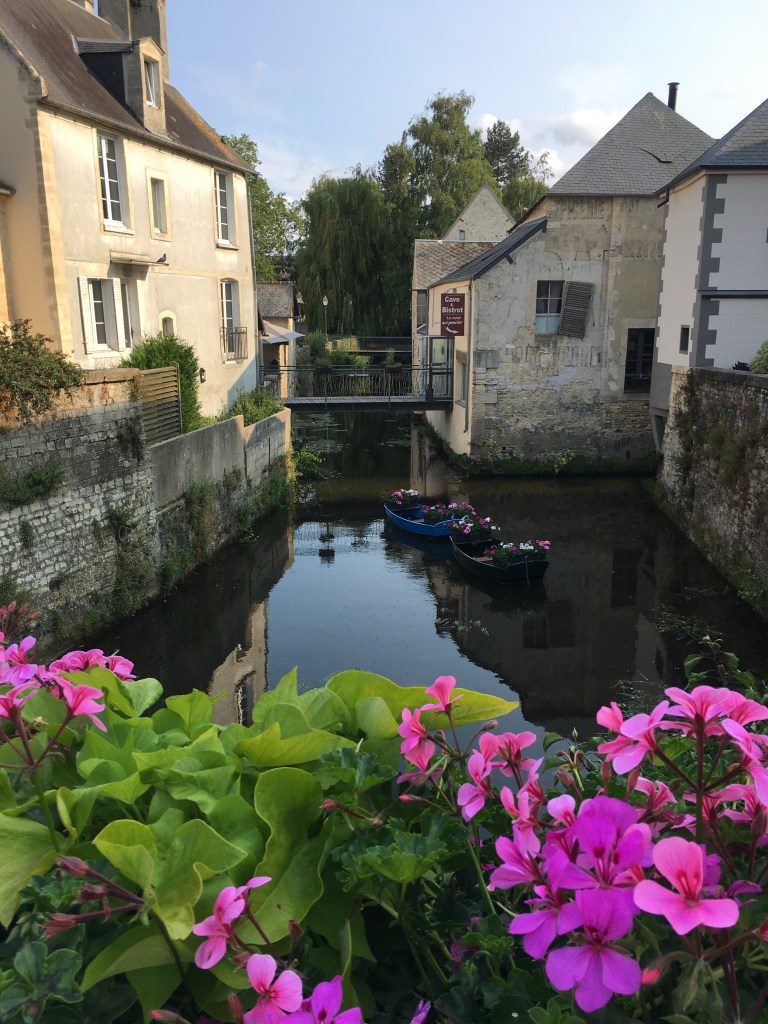
It is fair to say that I have never been more interested to learn about “1066 and all that.” A Macalester Wallace Grant for Scholarly Research enabled me to do some on-site research in England and France in the summer of 2023. I travelled to Normandy via the Channel to better understand the cultural context behind the Norman Conquest. At Rouen, I saw the powdered heart of Richard I. I conducted research at the BL, Lambeth Palace Library, Lincoln’s Inn, the Museum of the Mind, the Globe’s Library and Archive, and the Wellcome Library. [Pictured: Bayeux, France. Author’s photo, 2023.]
In the summer of 2022, I completed an initial round of archival research supported by a Paul O. Kristeller Fellowship from the Renaissance Society of America. I worked at the BL and Lambeth Palace Library, and visited the ruins of Kenilworth and spent some time in Stratford-upon-Avon. My post-tenure sabbatical year (2022-23) was devoted to developing the project in the company of brilliant colleagues of the ACMRS RaceB4Race Second Book Institute (I was a member of the year 2 cohort).
For more on “ablenationalism,” a critical term coined by disability scholars David T. Mitchell and Sharon L. Snyder, read their excellent book.
In Progress
Works in the pipeline:
- An essay on community and law in Measure for Measure, co-authored with Jessica Apolloni.
- A new critical edition of Richard II for Cambridge UP.
- A special issue on “Disability and Racial Capitalism” co-edited with Andrew Bozio.
- Developing some public facing writing.
 Penelope Geng